A press release for the 2026 Intermountain West Ozone Exchange from 6/29/2026 is
available here. Colorado Air Quality Enterprise Awards $300,000 for
Intermountain West Ozone Exchange Conference
The North Front Range Metropolitan Planning Organization (NFRMPO) is jointly hosting a 3 day conference with Pikes Peak Area Council of Governments (PPACG) on ozone science and attainment challenges specific to the Intermountain West states. Planning is currently underway – please check in here for updates and fill out our interest form at the bottom of the page to stay updated!
Virtual Town Halls
Two Town Halls were held in May and June 2026.
Sponsorship Information
We are bringing together researchers, transportation agencies, air quality professionals, local governments, industry leaders, and community members from across the Intermountain West Region to advance meaningful conversations about ozone, air quality, and regional solutions.
Your sponsorship helps support:
- Public education and outreach
- Collaboration across states and communities
- Reduced registration costs to encourage participation
- Research and information sharing on air quality challenges and solutions
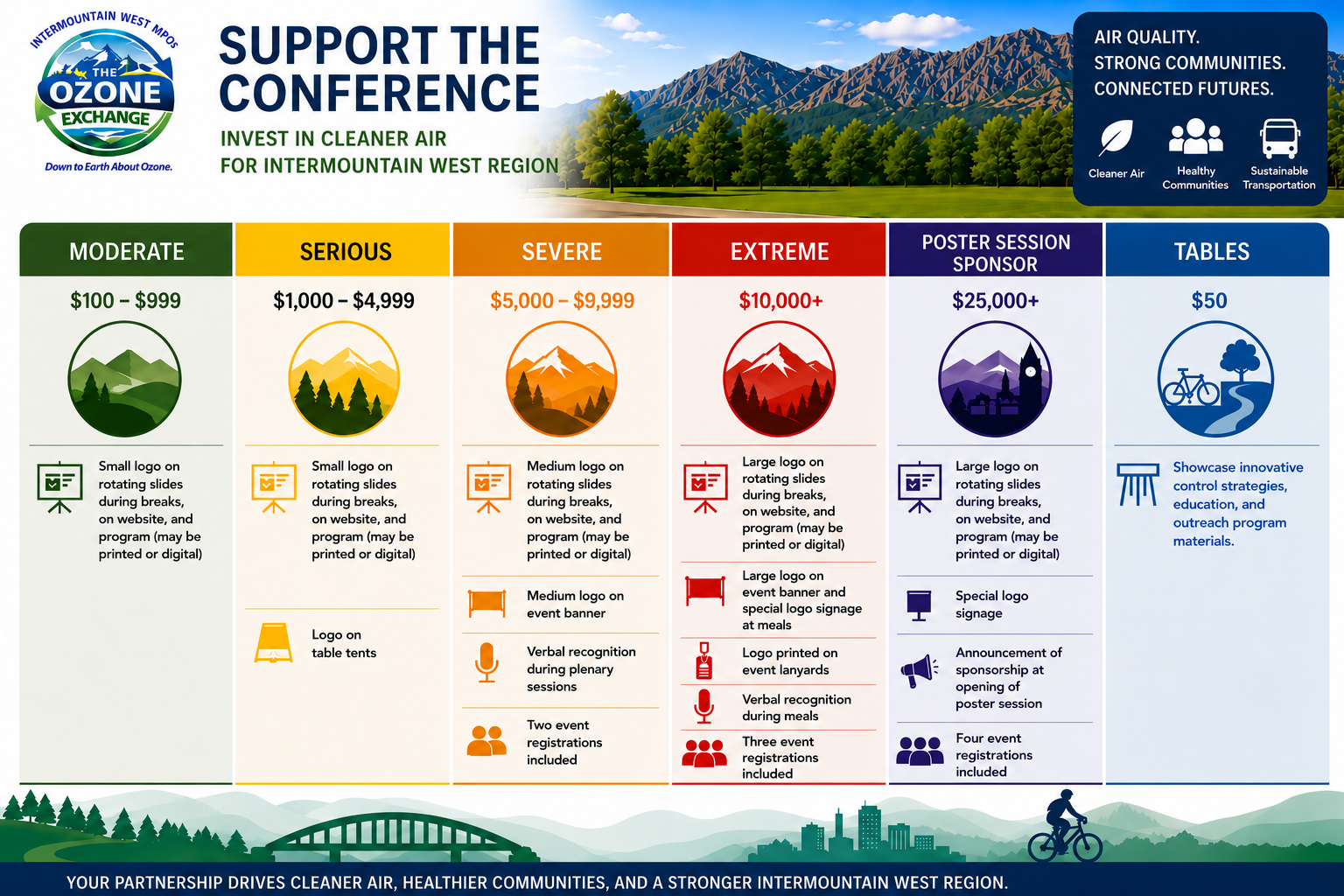
Sponsorship opportunities are now available at multiple levels, including event recognition, logo placement, signage, and more. Interested in sponsoring the event? Reach out to imwozone@outlook.com to confirm your sponsorship.
Exchange details
Date: October 26-28, 2026
Location: Pedersen Toyota Center at the Ranch Events Complex (5280 Arena Circle, Loveland, CO 80538)
Hosts: NFRMPO and PPACG
Hotel options: Coming Soon
Registration cost: Coming Soon
Travel scholarship availability: We acknowledge the current funding challenges faced by the research community, governments, and community groups, thus plan to provide a portion of awarded funding from Colorado’s Air Quality Enterprise to provide some degree of presenter stipends and/or participant scholarships based on need.
Why do we need this exchange?
Ozone levels in the intermountain west are no longer responding to state initiatives reducing human-made pollutant emissions that contribute to ozone production.
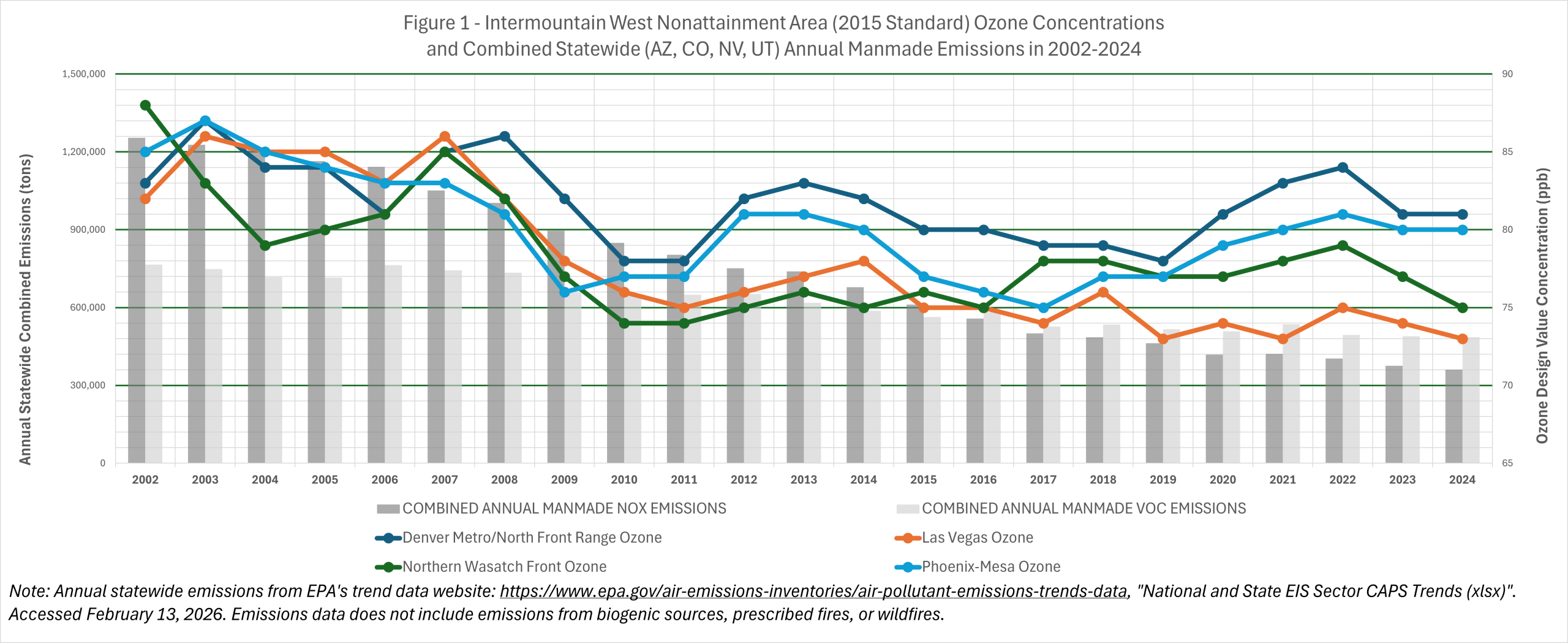
Ozone is not directly emitted into the atmosphere, it is chemically created by combining nitrogen oxides (NOx) and volatile organic compounds (VOCs) in the presence of sunlight. NOx and VOC are called ozone precursors. In areas where the ozone monitors show exceedance of the National Ambient Air Quality Standards (NAAQS) for ozone, local air agencies must reduce ozone levels by reducing these ozone precursors. However, in IMW nonattainment areas contributions from high background levels, natural sources, wildfires and related mitigation activities, international sources, and more appear to unduly influence whether areas can attain or come into attainment of the NAAQS. These sources of ozone precursors and ozone are not within any one state’s authority to control.
The last time a regional ozone conference was held was in 2016 by the US Environmental Protection Agency (EPA). Given the pressing need for understanding the ozone attainment challenges in the IMW states, this conference provides a regional venue in which to broadly share research findings and collectively discuss solutions.
IMW ozone nonattainment areas for the 2015 ozone NAAQS (70 ppb)
- Denver Metro/North Front Range, Colorado (map)
- Phoenix-Mesa, Arizona (map)
- Las Vegas in Clark County, Nevada (map)
- Northern Wasatch Front and Uinta Basin, Utah (map)
What are the goals for this exchange?
- Sharing information among IMW air quality agencies, metropolitan planning organizations, academic researchers, industry, local governments, community groups, and members of the public
- Education on the EPA’s State Implementation Plan process and Clean Air Act requirements and provisions
- Recognition and prioritization of unique regional challenges and considerations faced in the IMW states
- Discussing near-term and longer-term solutions and communication planning
- Recognition of research gaps still needed to be filled to help inform decision makers
This conference will not debate ozone health and environmental effects, the setting of the ozone standard, nor advocate for specific statutory, regulatory or policy changes.
General Exchange Program
We anticipate the general conference program to be as follows:
Day 1 – Air quality planning (legal requirements, realities and presentations from AZ, CO, NV and UT air quality planning agencies),
Day 2 – Air quality research (completed and on-going), and
Day 3 – Air quality public health communications and research gaps.
However, the organizing committee will use the abstract submissions to inform the final program and thus this rough program is subject to change.
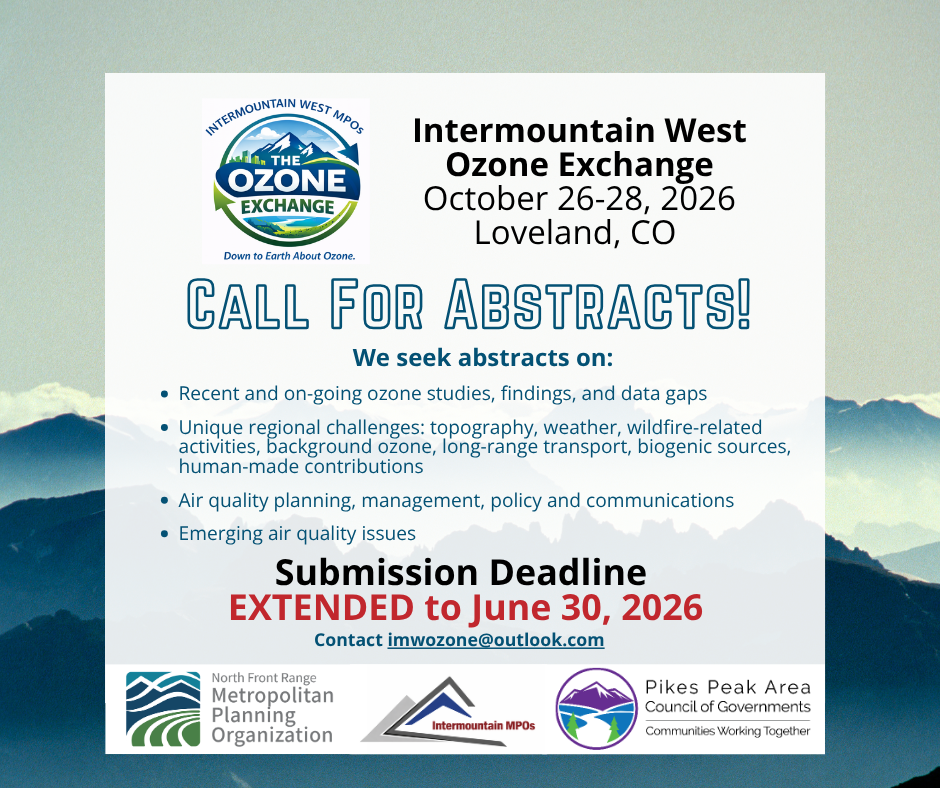
Call for abstracts – Extended Deadline June 30, 2026
Please submit your abstracts by June 30, 2026 through this Google Form
Abstract themes:
- Recent and on-going ozone studies, findings and data gaps
- Unique regional challenges and considerations faced in the intermountain west, including topography, weather, wildfire related activities and natural events, biogenic emissions, background ozone, long-range transport, and local and state human-made contributions
- Options to address those unique challenges, including those currently available in the existing statutory and regulatory frameworks, and other near-term and/or long-term solutions
- Public communication on high ozone days or anticipated high ozone days, and measuring communications effectiveness
- Emerging air quality issues (e.g., artificial intelligence, multipollutant interactions and management, consumer products, behavioral changes, population dynamics)
Who should attend and why
Anyone concerned about ozone in the intermountain west and wanting to better understand why areas are challenged in meeting ozone standards despite significant efforts to reduce air pollution is invited to attend. This includes researchers, government officials, air quality planners, industry and environmental representatives, community members and more. While technical information will be presented, presenters will also share thoughts about what the information might mean for local communities. The conference will also provide opportunities for roundtable discussions among attendees choosing to participate.
Spread the word
Help us spread the word of the 2026 Intermountain West Ozone Exchange with the following documents:
English handout
Spanish handout
Information Sign-up Form
Want to learn information and details about the 2026 Intermountain West Ozone Exchange as they are announced? Fill out the following form to receive email communications about the event!
Contact information
For questions and sponsorship inquiries, please contact the IMW Ozone Conference Planning Committee at imwozone@outlook.com.
Planning Committee Members
Elizabeth Relford
Director, North Front Range Metropolitan Planning Organization (NFRMPO)
Andrew Gunning
Director, Pikes Peak Area Council of Governments (PPACG)
Dena Wojtach
President, Two Roads Environmental
Angie Martell
Environmental Planner, PPACG
Dr. Annareli Morales
Air Quality Policy Analyst, Weld County Dept. of Public Health and Environment
Becky Karasko
Transportation Planning Director, NFRMPO
Abstract Review Committee Members
Ryan Bares
Environmental Scientist, Utah Department of Environmental Quality
Dr. Fariba Soltani
Transportation Analyst, Wasatch Front Regional Council
Matthew Poppen
Director of Environmental Planning, Maricopa Association of Governments
Yousaf Hameed
Principal Air Quality Specialist, Clark County Department of Environment and Sustainability
Sarah Downes
Ozone SIP Unit Supervisor, Colorado Air Pollution Control Division
Dr. Annareli Morales
Air Quality Policy Analyst, Weld County Dept. of Public Health and Environment
Courtney Taylor
Principal, Ramboll
Dena Wojtach
President, Two Roads Environmental